

Three ways to add Synap
AI coding agent (fastest)
Install the skill and let Claude Code, Cursor, or Codex wire Synap in for you.
Framework package
Drop in the package for your framework: LangChain, LangGraph, and 16 more (below).
No-code (MCP)
Connect any MCP client with a URL and a token. No code.
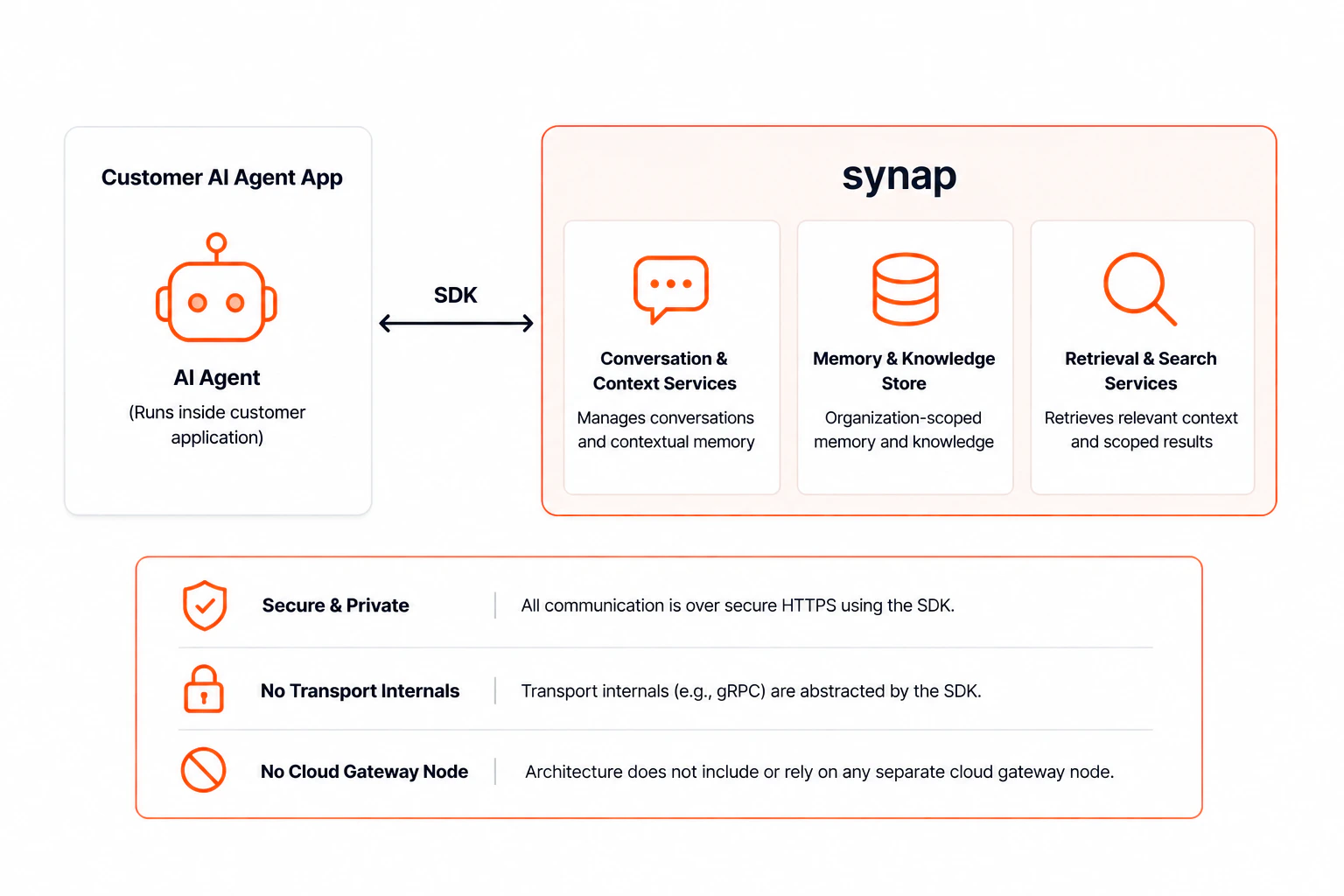
- Read-side failures degrade gracefully: a failed context fetch returns an empty result and logs an error, so your agent keeps running.
- Write-side failures surface explicitly: failed ingestion raises
SynapIntegrationError(or equivalent) so callers know if memory persistence failed. - Same scoping model everywhere: every package accepts
user_id, optionalcustomer_id, and optionalconversation_id.
How integrations plug in
Every framework exposes a few hook points in its agent loop, and each Synap package maps onto the same set of points. No matter which framework you use, an integration plugs in through one or more of these:
These fall into two modes:
- Always-on memory: history, callback, and retriever points run on every turn without the model deciding to. This is the default for memory-augmented agents and needs no prompt changes.
- Model-driven memory: tools let the agent choose when to read or write memory. Use this when you want the model to reason about what to remember or look up, or when always-on context would be too broad.
Available Integrations
No-code (MCP)
Connect Gumloop, n8n, Claude, or any MCP client with just a URL and a token, no code.

LangChain
Memory, callbacks, retriever, and tools for LangChain chains and agents.
LangGraph
Checkpointer and cross-thread store for LangGraph graphs.

LlamaIndex
BaseMemory implementation and retriever for LlamaIndex pipelines.
OpenAI Agents
Search and store tools for the OpenAI Agents SDK.

Pydantic AI
Dependency dataclass and tool registration for Pydantic AI agents.

CrewAI
StorageBackend implementation for CrewAI’s unified Memory system.
AutoGen
Search and store
BaseTool implementations for AutoGen agents.
Google ADK
FunctionTool factory for Google Agent Development Kit agents.
Haystack
SynapRetriever and SynapMemoryWriter pipeline components for Haystack.
Agno
Drop-in
InMemoryDb replacement that routes user memories through Synap.Semantic Kernel
Kernel plugin with
search_memory and store_memory functions.Microsoft Agent Framework
Context and history providers for the Microsoft Agent Framework.
NeMo Agent Toolkit
MemoryEditor implementation for NVIDIA NeMo Agent Toolkit workflows.
LiveKit Agents
Context preloading and turn recording for LiveKit voice agents.

Pipecat
Frame processors for memory injection and recording in Pipecat pipelines.

Strands Agents
Native
MemoryStore, short-term context hook, tools, and anticipation-stream feed.
CAMEL-AI
Native
AgentMemory that augments CAMEL’s history with Synap recall and persistence.
Smolagents
Memory tools and a per-step turn recorder for Hugging Face Smolagents.
deepagents
A memory backend where
grep is a semantic search, plus query-conditioned recall middleware.
Claude Agent SDK
Hooks and MCP server for Anthropic’s Claude Agent SDK (Python & TypeScript).

Mastra
SynapMemory class and tools for Mastra (TypeScript).
Vercel AI SDK
Middleware that wraps any Vercel AI SDK model with automatic Synap context.
Vercel eve
Memory tools and a per-turn short-term-context resolver for eve agents.
Quick Comparison
Stream hook support is currently limited to two packages:
maximem-synap-strands-agents and @maximem/synap-vercel-adk. Every other package uses request-response only, which works on its own. For a live agent, the stream is the integration we recommend: see Agent Integration. You can drive it yourself with instance.listen alongside any package, or with no framework at all.The TypeScript packages build on the JavaScript SDK and need Node.js 20+. Context and memory operations run on Edge Runtime and Cloudflare Workers as well; the optional anticipation stream needs Node.js. See Installation → JavaScript and TypeScript SDK.
Prerequisites
Every integration requires a configuredMaximemSynapSDK instance:
Going further
- Patterns overview: reusable memory patterns across frameworks.
- Cookbook overview: end-to-end worked examples.