

memories.create() in it.
Why there is no ingestion call
Conversation turns you report withsend_message() are persisted to conversation history. When the conversation compacts, Synap promotes those raw turns into the long-term ingestion pipeline: the same extraction stages memories.create() runs, producing memories of the same quality.
Compaction happens on any of three triggers:
The token and message thresholds are configurable per Instance. The idle trigger is what makes this complete: a two-turn exchange that never approaches the other thresholds still compacts a few minutes after the user stops, and its turns still become memory.
Because the idle trigger catches whatever the thresholds miss, every conversation reaches long-term memory eventually. Reporting turns with
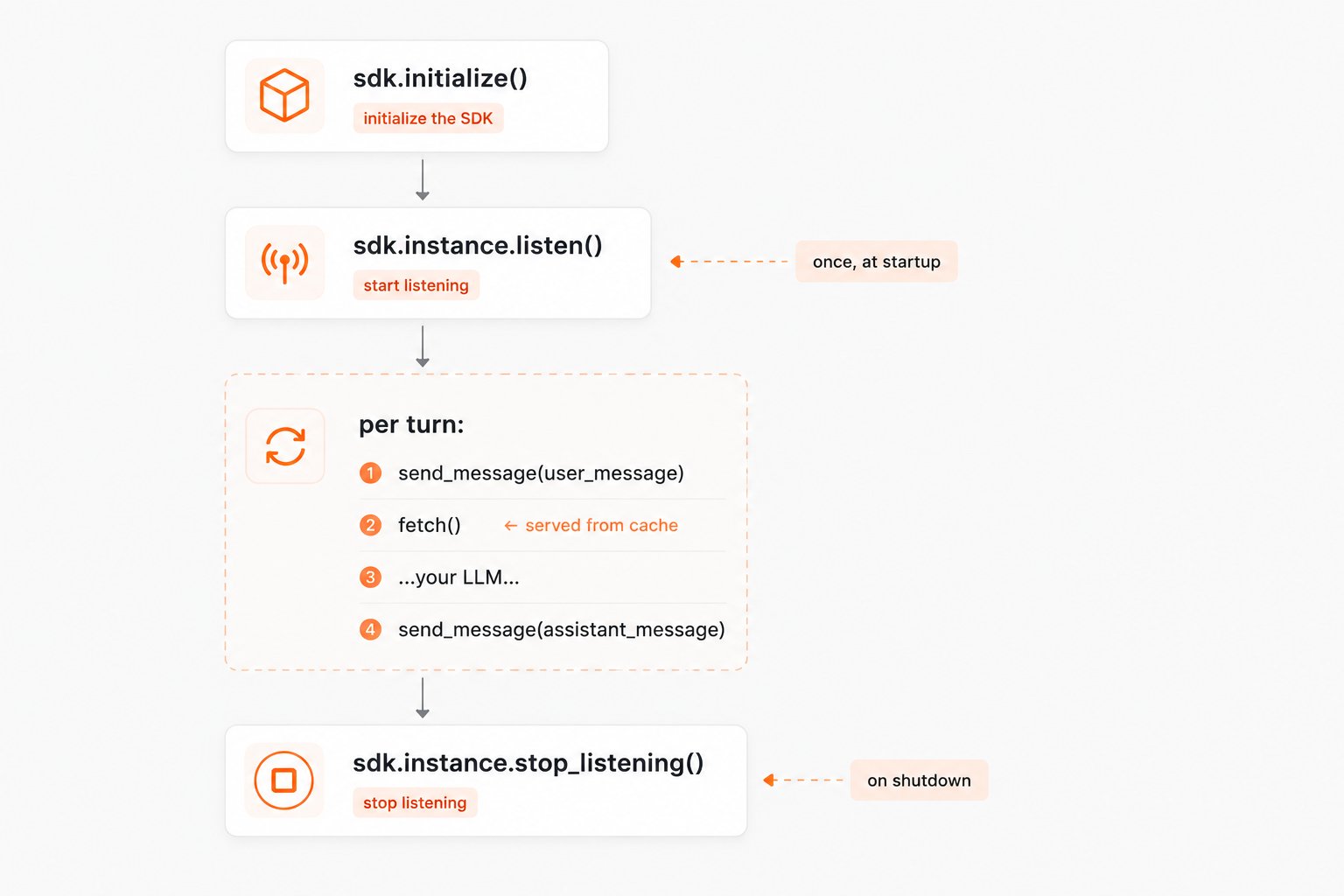
send_message() is sufficient on its own.The integration
1
Initialize once, at process startup
2
Open one stream for the process
Not one per user, not one per session. Scope travels on each call, not on the stream.See Real-Time Anticipation in a Server for quotas, reconnects, and the health check worth alerting on.
This step is the one JavaScript restriction. Every other call in this
loop runs on Edge and Workers;
listen() is gRPC, so it needs Node plus
@grpc/grpc-js and @grpc/proto-loader. Importing the SDK in an Edge
route stays safe, only the stream is unavailable there.3
Report each turn
assistant_message after the reply. Anticipation runs between turns, so this event is what pre-warms the next one.4
Close on shutdown
Report the whole turn, not just the two ends
Most integrations report the user’s message and the assistant’s reply and stop there. That works, and it leaves most of the value on the table. Synap then sees the question and the answer and nothing about the work in between, which is where the next question is usually decided. Five things happen in a turn. Report all five.Where each call goes
end_session is only for a conversation
that ends while the process lives on: a call hangs up, a chat window closes.
Check your own work
An integration is finished when all of these are true. If you are an agent wiring this up, check them before you report back.-
listen()is called once at startup, andstop_listening()on shutdown. - Every turn reports a
user_messageand anassistant_message. - Tool calls and results are reported, and share a
tool_call_id. - Reasoning is reported where the framework exposes it.
- Every event carries
conversation_idanduser_id(pluscustomer_idon B2B). - No
send_messagecall setsroleby hand for a tool or reasoning event. Use the typed methods; the role and the event type have to agree, and getting that wrong fails silently. -
end_sessionis called when a conversation ends and the process keeps running.
Requirements
required
The stream must stay open across turns. This integration suits servers, workers, and voice sessions, not per-request serverless functions, which cannot hold a connection.
required
Stream quotas are per Instance and per client. Opening one per user session exhausts them under real concurrency.
required
Reused across every turn of a conversation.
send_message() does not validate it, but fetch() and every other call do.What still uses REST
The stream is not the entire transport, and it is not meant to be. Two things go over HTTP:initialize(): resolves your client and instance from the API keyfetch()on an anticipation miss: pushed bundles cover what Synap predicted; anything it did not predict is fetched normally
fetch() is one call whether it resolves from the local anticipation cache in about a millisecond or falls through to the network.
When to still call memories.create()
Promotion is automatic but not instant. A turn becomes retrievable when its conversation compacts, which for a quiet conversation means about five minutes. Reach for explicit ingestion in three cases:
use memories.create
A fact the very next turn depends on, or a live demo showing memory forming. Waiting for compaction is not an option.
use memories.create
Promotion ingests conversation turns as conversation content. To set
document_type, mode, custom metadata, or to write at customer or client scope, ingest explicitly.use memories.create
Product docs, support tickets, CRM records, and backfills belong in ingestion, not on the stream.
Framework integrations
Five packages drive the stream for you, from the framework’s own hooks. With any other framework, or none, use the loop above directly: it is plain SDK calls and composes with anything.
Each package is silent unless
listen() is running, so adding one changes
nothing until you open a stream.
How anticipation works
The stream in depth: event types, cache behavior, and failure modes.
Running it in a server
Quotas, reconnects, and the silent failure to alert on.