

Status: Live in Playground · Try it: synap.maximem.ai/playground
Open the playground and pick Amazon: Shopping Assistant to see the reference implementation running before you build.
What you’ll build
A chat agent that:- Searches the catalog with the buyer’s preferences applied as filters by default
- Recalls preferences: dietary restrictions, allergies, sizes, materials, brand likes/dislikes
- Grounds in order history: “find me another of those running shoes I bought in March”
- Handles post-purchase: tracking, returns, replacement orders
When to use this recipe
Build this if your product:- Has a sizeable catalog where suggestion quality matters
- Tracks per-buyer order history you want the agent to reference
- Wants the agent to remember preferences across visits without making the buyer re-state them
- Needs the agent to take post-purchase actions (track, return, replace)
Architecture at a glance
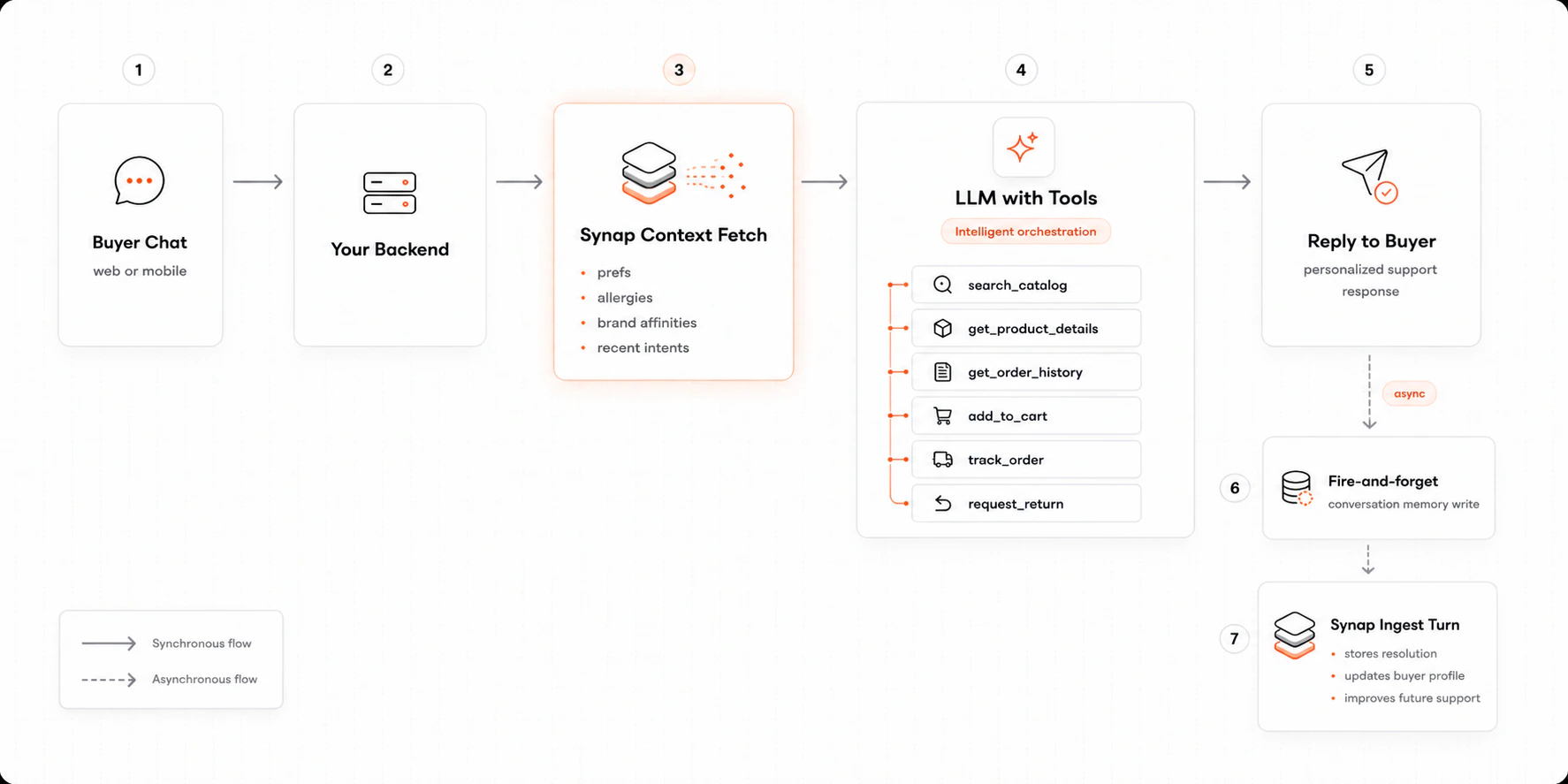
Stack
Prerequisites
- A Synap API key, see Authentication
- Internal APIs for catalog search, product details, orders, and returns
- Python recipe: Python 3.11+
- TypeScript recipe: Node.js 20+
Install
Configure
Build it
1. Identity & scoping
user_id = <stable buyer ID>: from authenticated sessionconversation_id = <session UUID>: per chat session
user_context_isolation is equals_customer and send user_id alone. A B2C instance does not accept customer_id: a call carrying it is rejected with HTTP 400.
conversation_id and user_id must be valid UUIDs. Generate session ids with crypto.randomUUID() (JS) or str(uuid.uuid4()) (Python), as shown below.2. Business tools
3. System prompt
System prompt
4. Wire memory + LLM + tools
Run & verify
Session 1
Session 2 (a week later, new conversation_id)
Inspect what got stored
Customize / extend
- Voice channel → swap the chat handler for Voice Concierge. The shopping tools transfer untouched.
- Multi-tenant marketplaces → move to a B2B instance (
user_context_isolation: "strict") and setcustomer_idper seller storefront. See Patterns → Multi-Tenant SaaS. - Replay historical orders into memory on launch so the agent is useful from day one. See Patterns → Replay History.
- Different framework → see AI Integrations for LangChain, LlamaIndex, CrewAI, etc.
- Support flavor → adapt this shape with
request_refundinstead ofrequest_return; see Uber: Customer Support.
Troubleshooting
Assistant ignores known allergies / dietary prefs- Confirm
synap_searchis being called (Python); inspect the agent trace. If the model isn’t calling it, sharpen the system prompt: “Before recommending food, beauty, or supplements, callsynap_searchfor the buyer’s restrictions.” - For the TS path with
synap.wrap, increasemaxResultsso the dietary memory makes it into the injected context.
- The agent has the buyer’s affinity but no negative feedback. Capture explicit rejections (“I didn’t like that one”) with
synap_store, or post-purchase ratings via your own pipeline →sdk.memories.create.
- Order data should be tool-fetched live, never cached in memory. If you see stale orders in suggestions, your tool is returning cached data, not Synap.
Related
- Integrations: OpenAI Agents SDK · Vercel AI SDK
- Concepts: Customized Memory Architectures · Memory Scopes
- Patterns: Replay History · Multi-Tenant SaaS
- Other recipes: Uber: Customer Support · Salesforce: Enterprise Sales Assistant